Quelle est la conjugaison de eat en anglais ? Quelles sont les définitions de ce verbe ? À quels synonymes, expressions et phrasal verbs est-il associé ?
Tableaux de conjugaison de eat en anglais
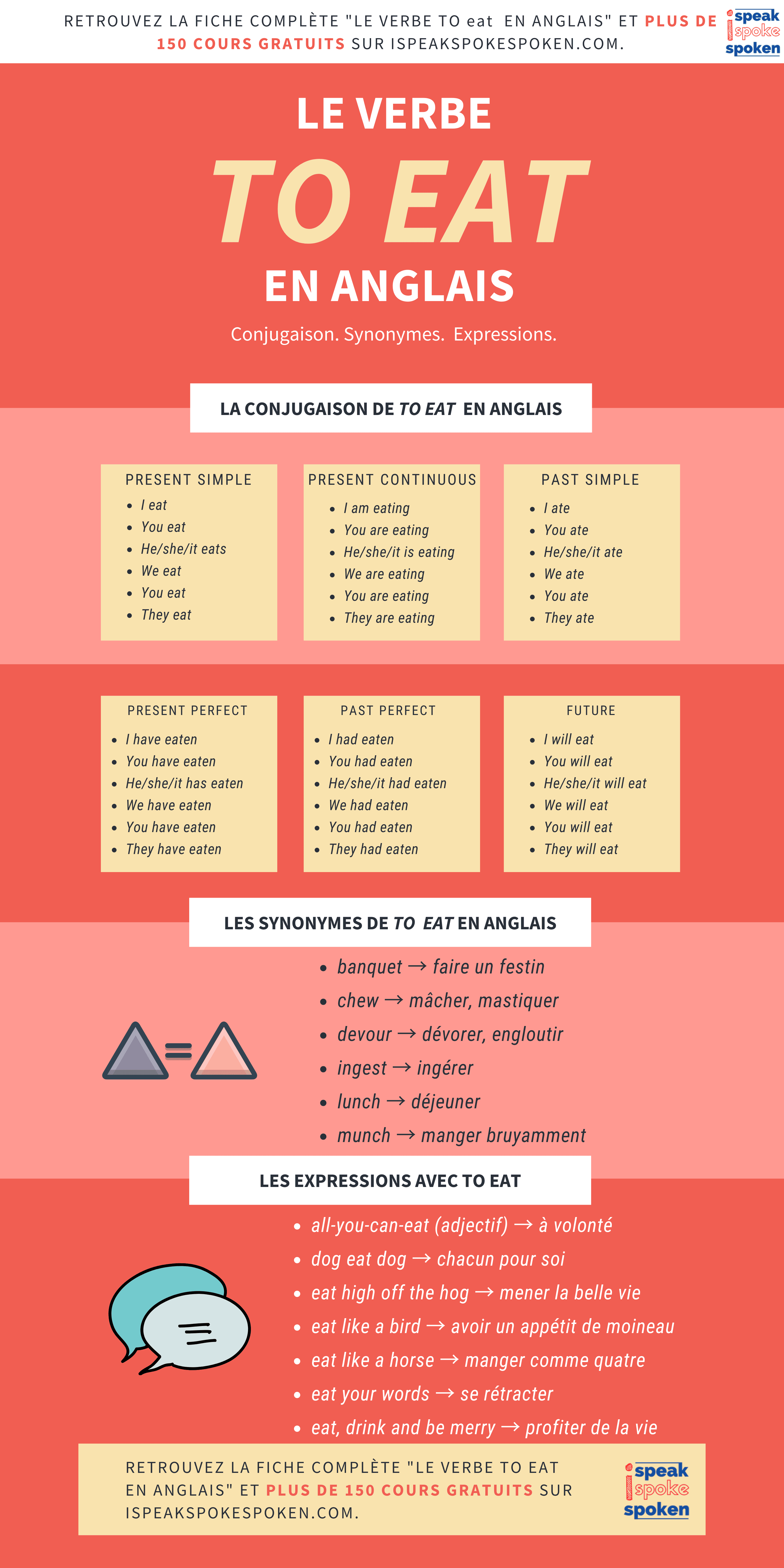
Conjugaison du verbe eat à l’indicatif
Le verbe eat au present simple
- I eat
- You eat
- He/she/it eats
- We eat
- You eat
- They eat
Le verbe eat au present continuous
- I am eating
- You are eating
- He/she/it is eating
- We are eating
- You are eating
- They are eating
Le verbe eat au past simple
- I ate
- You ate
- He/she/it ate
- We ate
- You ate
- They ate
Le verbe eat au past continuous
- I was eating
- You were eating
- He/she/it was eating
- We were eating
- You were eating
- They were eating
Le verbe eat au present perfect
- I have eaten
- You have eaten
- He/she/it has eaten
- We have eaten
- You have eaten
- They have eaten
Le verbe eat au present perfect continuous
- I have been eating
- You have been eating
- He/she/it has been eating
- We have been eating
- You have been eating
- They have been eating
Le verbe eat au past perfect
- I had eaten
- You had eaten
- He/she/it had eaten
- We had eaten
- You had eaten
- They had eaten
Le verbe eat au past perfect continuous
- I had been eating
- You had been eating
- He/she/it had been eating
- We had been eating
- You had been eating
- They had been eating
Le verbe eat au future
- I will eat
- You will eat
- He/she/it will eat
- We will eat
- You will eat
- They will eat
Le verbe eat au future continuous
- I will be eating
- You will be eating
- He/she/it will be eating
- We will be eating
- You will be eating
- They will be eating
Le verbe eat au future perfect
- I will have eaten
- You will have eaten
- He/she/it will have eaten
- We will have eaten
- You will have eaten
- They will have eaten
Le verbe eat au future perfect continuous
- I will have been eating
- You will have been eating
- He/she/it will have been eating
- We will have been eating
- You will have been eating
- They will have been eating
Conjugaison du verbe eat au conditionnel
Le verbe eat au conditional present
- I would eat
- You would eat
- He/she/it would eat
- We would eat
- You would eat
- They would eat
Le verbe eat au conditional present continuous
- I would be eating
- You would be eating
- He/she/it would be eating
- We would be eating
- You would be eating
- They would be eating
Le verbe eat au conditional perfect
- I would have eaten
- You would have eaten
- He/she/it would have eaten
- We would have eaten
- You would have eaten
- They would have eaten
Le verbe eat au conditional perfect continuous
- I would have been eating
- You would have been eating
- He/she/it would have been eating
- We would have been eating
- You would have been eating
- They would have been eating
Les autres formes
L’infinitif de eat
- to eat
Participe présent de eat
- eating
Participe passé de eat
- eaten
L’impératif de eat
- eat
- let’s eat
À l’instar de to drive, to come, to tell, to run et to know, to eat est un verbe irrégulier. Vous devez donc faire particulièrement attention aux terminaisons du passé.
Définition de eat en anglais
Que veut dire le verbe eat en anglais ?
Le Cambridge Dictionary donne plusieurs définitions du verbe eat.
Penchons-nous sur les principales :
1. To put or take food into the mouth, chew it, and swallow it
Vegetarians don’t eat meat.
→ Les végétariens ne mangent pas de viande.
2. To damage or destroy something
The substance has eaten into the concrete.
→ La substance a érodé le ciment.
Pour accéder à l’intégralité de la page du Cambridge Dictionary, cliquez ici !
Les phrasal verbs avec eat en anglais
Rappel : les phrasal verbs (ou “verbes à particule”) sont des verbes qui, lorsqu’ils sont suivis d’un autre mot (la particule), voient leur sens initial complété ou modifié.
Il existe trois phrasal verbs formés sur le verbe eat :
- eat away at somebody/something → ronger, dévorer (au sens figuré, comme un souci par exemple)
- eat in → manger à la maison
- eat into something → entamer (au sens figuré, comme un budget par exemple)
- eat out → sortir diner, aller au restaurant
- eat something away → éroder
- eat something up → gober, avaler (au sens figuré, comme un mensonge par exemple)
- eat up → finir son assiette, vider son assiette (familier)
Les synonymes de eat en anglais
En fonction du contexte, vous pouvez remplacer le verbe to eat par l’un des verbes suivants :
- banquet → faire un festin
- bite → croquer dans (un aliment)
- breakfast → prendre le petit-déjeuner
- chew → mâcher, mastiquer
- devour → dévorer, engloutir
- dine → dîner
- gorge → s’empiffrer, se goinfrer (familier)
- gormandize → manger goulûment
- graze → grignoter (familier)
- ingest → ingérer
- lunch → déjeuner
- munch → manger bruyamment
- nibble → grignoter
- nosh → bouffer, grailler (familier)
- pick → picorer
- scarf → engloutir
- scoff → s’enfiler (un aliment, familier)
- snack → grignoter
- sup → souper (terme très vieilli)
- swallow → avaler
- wolf → dévorer, engloutir
Expressions avec eat en anglais
- all-you-can-eat (adjectif) → à volonté
- dog eat dog → chacun pour soi
- eat crow (anglais américain) → admettre son erreur (familier)
- eat dirt → mordre la poussière (familier)
- eat high off the hog → mener la belle vie
- eat humble pie (anglais britannique) → faire amende honorable (familier)
- eat like a bird → avoir un appétit de moineau
- eat like a horse → manger comme quatre
- eat out of somebody’s hand → manger dans la main de quelqu’un (au sens figuré)
- eat your fill → manger à satiété
- eat your words → se rétracter
- eat, drink and be merry → profiter de la vie
- have your cake and eat it → avoir le beurre et l’argent du beurre
- safe to eat (adjectif) → sans risque pour la santé (pour de la nourriture)